- A glossary for translation projects and communication by Sherab
Reference sites
Saturated Fat (SFA) molecules completely packed or "saturated" with hydrogen. Generally hard at room temperature. Often considered "bad fats" because they have consistently been linked to an increased risk of heart disease and some forms of cancer.
Monounsaturated Fatty Acids (MFA) fatty acids having one spot in the carbon chain where hydrogen is missing. Fats high in these MFA are generally liquid at room temperature and semi-solid when refrigerated. These are generally considered "good fats"; they are beneficial to health and can protect against chronic diseases, especially heart disease. These are neutral or slightly beneficial in their effects on total cholesterol levels and do not decrease HDL ("good") cholesterol; may even slightly increase it. Some evidence show MFA reduce blood presure and enhance blood flow... Main dietary sources are olives, olive oil, canola oil, avacados, most nuts (except for walnuts and butternuts), high-oleic sunflower oil, and high-oleic safflower oil.
Polyunsaturated Fat (PUFA) fat molecules having more than one spot in the carbon chain where hydrogen is missing. Fats high in PUFA are liquid at room temperature and when refrigerated. Reviews concerning their health effects are inconsistent.... Main dietary sources are vegetable oils, seeds, nuts, grains, legumes, and other plant foods.
- Lie on your belly on the floor; crown of head touching a wall
- Chest liftup and put hands on the wall like doing Downward Dog
- Relax and hang there for a minute, then 2 to 5 minutes
- Master Vajrasana till comfortable bum on floor between feet
- Proceed to lean back, elbows first, lower your back and head to the floor
- Grab opposite elbows over your head; Relax totally for 2-5 minutes
- on all fours, arch the back and tip the tail up to the ceiling on each inhalation; on each exhalation, round the back and tuck the tail and head under. Repeat slowly and with awareness for 2 or 3 minutes.
- Lie on your stomach with arms overhead. Reach back with your right hand to grasp the right foot.
- Inhale and press your pubic bone gently into the floor. This encourages you to center the pivot point of the arch in the backbend at the apex of the sacrum. As you inhale, lift your upper body and right thigh off the floor. Keep the back of the neck long. Exhale and return to the floor. Continue for several breaths then repeat on the left side.
- To contrast the results, do several movements without first pressing the pubic bone into the floor. Notice the increased compression in the lower back.
- If you are able, do the full pose by lifting both thighs and the upper body off the floor as you inhale and anchor the pubic bone into the floor. If you feel any compression in the lowback, practice one side at a time until you learn to lengthen the spine and pivot from the sacral apex.
- Do several more Catcows as a counterpose.



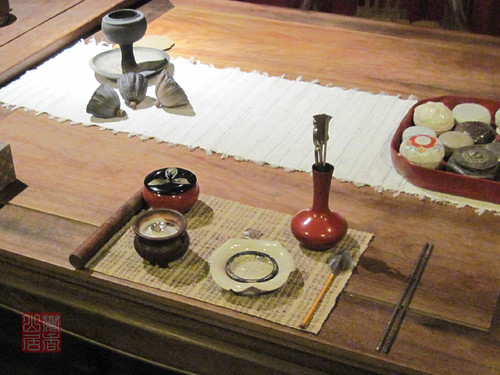
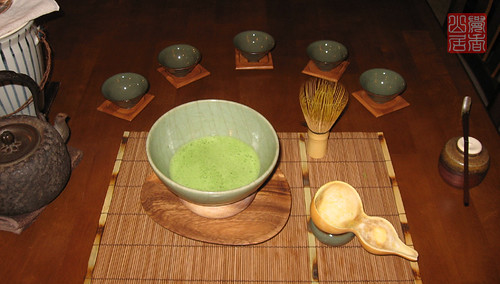
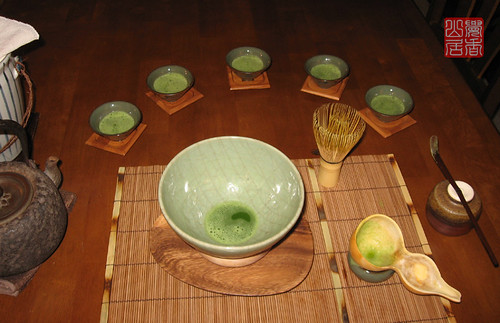
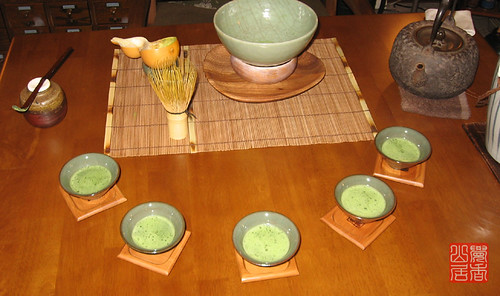
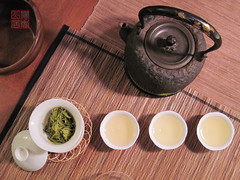
I have accepted, with honor, an invitation to perform "The Way of Tea" (茶道 or "Tea Ceremony") at the 2010 Ohio Chinese Festival. Not only I'm going to demonstrate the traditional way of tea, but also I intend to introduce some easy but proper ways of enjoying tea on a daily base (in other words, occassions such as when you are working at your office, or on the way to go).

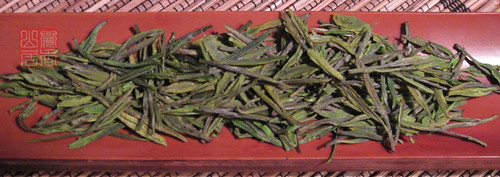





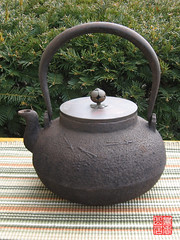
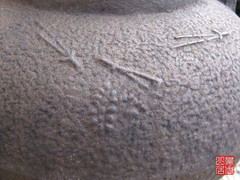 The first time this motif caught my eyes was when I bought a tetsubin with kanji 松風(wind through pine trees) on one side and some "strange" design on the other. At that time, I wasn't sure that the needle like leaves are pine needles and the fruit like thing is a pine cone. Later on I learned that this motif is called 松葉絵 matsu-e(drawing of pine needles). Sometimes, pine cones, called 松ぼっくり(松毬), are also accompanied.